Summary: This first collection of fifteen stories deals with the strategies of emotional survival and offers sharp, brittle, and intelligent looks at staying alive, at how to manage a life truly one's own, and how to resist becoming a victim - (Baker & Taylor)
Kirkus Review
Fifteen tiny stories, some only a few paragraphs long--in a slight collection (less than 100 pages of text) that features, principally, the adolescent-angst sensibility of strung-out young women living in southern California. Hempel's narrators murmur about lost childhoods, rotten men, adored pets; they deliver routine one-liners--about TV commercials, award-shows, and other minor cultural manifestations. Sometimes, as in the similarly thin work of Lorrie Moore (Self-Help, p. 58), there are rueful little instructions on how to deal with all the anxiety: "Here is what you do. You ease yourself into a tub of water, you ease yourself down. You lie back and wait for the ripples to smooth away. Then you take a deep breath, and slide your head under, and listen for the playfulness of your heart." (Here, and elsewhere, Hempel--occasionally in bald, hollow imitation of Joan Didion--strains for a severe sort of lyricism.) But, though the recurring theme of grief (mourning a broken marriage, a death, the past, etc.) provides a hint of resonance, too often the approach is cheaply manipulative, an artsy equivalent to tabloid sensationalism--as in "When It's Human Instead of When It's Dog" (about the sad carpet stain in a fancy home that marks the spot where the lady-of-the-house died). And only two pieces really attempt to go beyond the studied juxtaposition of whimsical/portentous anecdotes, ironic observations, and refrigerated self-pity: "Beg, Sl Tog, Inc, Cont, Rep" presents the familiar setup of two friends, one about to give birth and one recovering from an abortion, with knitting as an over-obvious symbol of both pulling-oneself-together and rejected/frustrated maternal yearnings; "In the Cemetery Where Al Jolson Is Buried" is somewhat more successful--layering the plainly affecting story of a friend's death with dark jokes and self-deprecation. . . though here too the central sentiment is unnecessarily, moistly emphasized. ("Baby, come hug, Baby, come hug, fluent now in the language of grief.") Borrowed mannerisms for the most part, with only a few glimmers of emotional substance or fresh voicing. (Kirkus Reviews, March 15, 1985)
Check Availability
Showing posts with label brent's picks. Show all posts
Jan 1, 2016
Prospero's daughter - Elizabeth Nunez
Summary: Exiled from England for performing dangerous experiments on his patients, Peter Gardner flees to the Caribbean with his beautiful young daughter, Virginia, raising her in isolation except for the a few natives, including Carlos, a young boy of mixed race with whom Virginia develops a forbidden friendship that blooms into love. 12,000 first printing. - (Baker & Taylor)
Booklist Reviews
Through one family's unique circumstances, the always-eloquent Nunez invokes larger themes of race, class, and colonialism. In the late 1950s, mad scientist Peter Gardner flees England to escape charges that he experimented on his patients. He and his young daughter, Virginia, settle on an isolated leper colony off the coast of Trinidad. They soon take over the house of a mixed-race orphan, Carlos, who was left in the care of a dying housekeeper. Gardner imposes a strict regimen on the household; trumpets the superiority of the white race; alternately treats Carlos as a slave and as an experiment by educating him about music, literature, and science; and devotes extraordinary amounts of time to cultivating hybrid flowers. His daughter, Virginia, responds to Carlos'great kindness and patience, and their abiding friendship, carried out in secret, blossoms into a love affair that threatens Gardner's worldview and puts the couple in danger. Although the enthralling story line loses some power in the final section, Nunez has crafted a beautiful, layered novel that echoes both The Tempest and Heart of Darkness. ((Reviewed November 15, 2005)) Copyright 2005 Booklist Reviews.
Check Availability
Booklist Reviews
Through one family's unique circumstances, the always-eloquent Nunez invokes larger themes of race, class, and colonialism. In the late 1950s, mad scientist Peter Gardner flees England to escape charges that he experimented on his patients. He and his young daughter, Virginia, settle on an isolated leper colony off the coast of Trinidad. They soon take over the house of a mixed-race orphan, Carlos, who was left in the care of a dying housekeeper. Gardner imposes a strict regimen on the household; trumpets the superiority of the white race; alternately treats Carlos as a slave and as an experiment by educating him about music, literature, and science; and devotes extraordinary amounts of time to cultivating hybrid flowers. His daughter, Virginia, responds to Carlos'great kindness and patience, and their abiding friendship, carried out in secret, blossoms into a love affair that threatens Gardner's worldview and puts the couple in danger. Although the enthralling story line loses some power in the final section, Nunez has crafted a beautiful, layered novel that echoes both The Tempest and Heart of Darkness. ((Reviewed November 15, 2005)) Copyright 2005 Booklist Reviews.
Check Availability
The tiger - John Vaillant
Summary: It's December 1997, and a man-eating Siberian tiger is on the prowl outside a remote village in Russia's Far East. The tiger isn't just killing people, it's annihilating them, and a team of men and their dogs must hunt it on foot through the forest in the brutal cold. As the trackers sift through the gruesome remains of the victims, they discover that these attacks aren't random. An absolutely gripping tale of man and nature that leads inexorably to a final showdown in a clearing deep in the taiga.
Booklist Reviews
Set in Russia’s Maritime Territory, Vaillant’s story concerns a tiger of the endangered Amur subspecies that killed three hunters in 1997. Expanding from the incidents’ central facts, Vaillant’s narrative explores humans’ relationship with predatory animals in general, with the Amur tiger as the specific example. Literary, folkloric, and scientific sources combine into a deeply sensitive depiction of the tiger’s adaptation to its forested, mountainous, and wintry environment. As he recounts how Russians such as the hunters in question also attempt to extract a living from the taiga, possibly including illegal poaching of the tiger, Vaillant posits the tiger’s thoughts about the competition, inferring its intelligence from a conservation warden’s investigation into the cases of the unfortunate hunters, who were felled in ambush-style attacks. Interest in Vaillant’s work, which climaxes in the warden’s pursuit of the deadly tiger, will partake of humans’ instinctual fear of large carnivores, the modern imperative to preserve them from extinction, and readers of Vaillant’s The Golden Spruce (2005), a positively reviewed, deep-drilling work, also about the nexus between humans and the natural world. Copyright 2010 Booklist Reviews.
Check Availability
Booklist Reviews
Set in Russia’s Maritime Territory, Vaillant’s story concerns a tiger of the endangered Amur subspecies that killed three hunters in 1997. Expanding from the incidents’ central facts, Vaillant’s narrative explores humans’ relationship with predatory animals in general, with the Amur tiger as the specific example. Literary, folkloric, and scientific sources combine into a deeply sensitive depiction of the tiger’s adaptation to its forested, mountainous, and wintry environment. As he recounts how Russians such as the hunters in question also attempt to extract a living from the taiga, possibly including illegal poaching of the tiger, Vaillant posits the tiger’s thoughts about the competition, inferring its intelligence from a conservation warden’s investigation into the cases of the unfortunate hunters, who were felled in ambush-style attacks. Interest in Vaillant’s work, which climaxes in the warden’s pursuit of the deadly tiger, will partake of humans’ instinctual fear of large carnivores, the modern imperative to preserve them from extinction, and readers of Vaillant’s The Golden Spruce (2005), a positively reviewed, deep-drilling work, also about the nexus between humans and the natural world. Copyright 2010 Booklist Reviews.
Check Availability
Indian bride - Karin Fossum
Summary: Inspector Konrad Sejer heads up the investigation into a brutal murder after the battered body of a woman is found outside of the town of Elvestad on the same day that the townspeople are expecting to meet the new Indian bride of local bachelor Gunder Jomann, who unexpectedly has returned home married after a two-week trip to India. By the author of Don't Look Back. - (Baker & Taylor)
Booklist Reviews
*Starred Review* Over the course of a few days, Norwegian bachelor Gunder Jomann experiences both euphoria and utter despair. In India, he meets and marries Poona, the woman of his dreams. He returns to his tiny village of Elvestad, with his new bride scheduled to arrive in a matter of weeks. A family emergency delays Gunder on the day Poona arrives. Tragedy ensues before they can reconnect; she is found brutally murdered less than a mile from her new husband's house. Who in tranquil Elvestad could commit such a heinous act? Shy, contemplative Chief Inspector Konrad Sejer knows that evil lurks deep within even the most seemingly innocent souls. With his baby-faced partner, Jacob Skarre, he methodically follows but a handful of clues. As time passes, the list of suspicious characters grows. There's muscle-bound Goran, whose affable manner belies his might; local café owner Einar, who harbors a general dislike for humankind; and Linda, an attention-starved teenager who dispenses half-truths and lies. This fourth in the Inspector Sejer series showcases the crisp prose and unsettling scenarios that have made Fossum (When the Devil Holds the Candle, 2006) one of Europe's most successful crime novelists. Like a Scandinavian winter, this potent psychological thriller chills right to the bone.
Check Availability
Booklist Reviews
*Starred Review* Over the course of a few days, Norwegian bachelor Gunder Jomann experiences both euphoria and utter despair. In India, he meets and marries Poona, the woman of his dreams. He returns to his tiny village of Elvestad, with his new bride scheduled to arrive in a matter of weeks. A family emergency delays Gunder on the day Poona arrives. Tragedy ensues before they can reconnect; she is found brutally murdered less than a mile from her new husband's house. Who in tranquil Elvestad could commit such a heinous act? Shy, contemplative Chief Inspector Konrad Sejer knows that evil lurks deep within even the most seemingly innocent souls. With his baby-faced partner, Jacob Skarre, he methodically follows but a handful of clues. As time passes, the list of suspicious characters grows. There's muscle-bound Goran, whose affable manner belies his might; local café owner Einar, who harbors a general dislike for humankind; and Linda, an attention-starved teenager who dispenses half-truths and lies. This fourth in the Inspector Sejer series showcases the crisp prose and unsettling scenarios that have made Fossum (When the Devil Holds the Candle, 2006) one of Europe's most successful crime novelists. Like a Scandinavian winter, this potent psychological thriller chills right to the bone.
Check Availability
Life after life - Kate Atkinson
Summary: "What if you could live again and again, until you got it right? On a cold and snowy night in 1910, Ursula Todd is born to an English banker and his wife. She dies before she can draw her first breath. On that same cold and snowy night, Ursula Todd is born, lets out a lusty wail, and embarks upon a life that will be, to say the least, unusual. For as she grows, she also dies, repeatedly, in a variety of ways, while the young century marches on towards its second cataclysmic world war. Does Ursula's apparently infinite number of lives give her the power to save the world from its inevitable destiny? And if she can -- will she? Darkly comic, startlingly poignant, and utterly original -- this is Kate Atkinson at her absolute best"-- Provided by publisher.
Booklist Reviews
*Starred Review* In a radical departure from her Jackson Brodie mystery series, Atkinson delivers a wildly inventive novel about Ursula Todd, born in 1910 and doomed to die and be reborn over and over again. She drowns, falls off a roof, and is beaten to death by an abusive husband but is always reborn back into the same loving family, sometimes with the knowledge that allows her to escape past poor decisions, sometimes not. As Atkinson subtly delineates all the pathways a life or a country might take, she also delivers a harrowing set piece on the Blitz as Ursula, working as a warden on a rescue team, encounters horrifying tableaux encompassing mangled bodies and whole families covered in ash, preserved just like the victims of Pompeii. Alternately mournful and celebratory, deeply empathic and scathingly funny, Atkinson shows what it is like to face the horrors of war and yet still find the determination to go on, with her wholly British characters often reducing the Third Reich to "a fuss." From her deeply human characters to her comical dialogue to her meticulous plotting, Atkinson is working at the very top of her game. An audacious, thought-provoking novel from one of our most talented writers. HIGH-DEMAND BACKSTORY: Atkinson's publisher is pulling out all the stops in marketing her latest, which will no doubt draw in many new readers in addition to her Jackson Brodie fans. Copyright 2012 Booklist Reviews.
Check Availability
Booklist Reviews
*Starred Review* In a radical departure from her Jackson Brodie mystery series, Atkinson delivers a wildly inventive novel about Ursula Todd, born in 1910 and doomed to die and be reborn over and over again. She drowns, falls off a roof, and is beaten to death by an abusive husband but is always reborn back into the same loving family, sometimes with the knowledge that allows her to escape past poor decisions, sometimes not. As Atkinson subtly delineates all the pathways a life or a country might take, she also delivers a harrowing set piece on the Blitz as Ursula, working as a warden on a rescue team, encounters horrifying tableaux encompassing mangled bodies and whole families covered in ash, preserved just like the victims of Pompeii. Alternately mournful and celebratory, deeply empathic and scathingly funny, Atkinson shows what it is like to face the horrors of war and yet still find the determination to go on, with her wholly British characters often reducing the Third Reich to "a fuss." From her deeply human characters to her comical dialogue to her meticulous plotting, Atkinson is working at the very top of her game. An audacious, thought-provoking novel from one of our most talented writers. HIGH-DEMAND BACKSTORY: Atkinson's publisher is pulling out all the stops in marketing her latest, which will no doubt draw in many new readers in addition to her Jackson Brodie fans. Copyright 2012 Booklist Reviews.
Check Availability
A supposedly fun thing I'll never do again: essays and arguments - David Foster Wallace
A supposedly fun thing I'll never do again: essays and arguments - Wallace, David Foster
Summary: A collection of keen observations, witty analysis, and essays on a wide range of subjects exposes the fault lines in today's society - (Baker & Taylor)
Booklist Reviews
Celebrated Illinoisan writer Wallace's meganovel, Infinite Jest (1996), was megasuccessful, and these intelligent, funny essays are outstanding. In "Derivative Sport in Tornado Alley," Wallace presents himself as a young Midwest tennis star with an unathletic, intuitive, yet winning style of play. But Wallace writes about far more than the sum of his self, widening his field of vision to embrace wind, earth, and mathematics, creating a virtual cyclone with his highly idiosyncratic perceptions, perfectly correct cadence, and casually hip lexicon. He applies this arsenal of literary power tools to even greater effect in one of the most original, comprehensive analyses yet of television and the pervasive "culture of watching," discussing such fine points as the tyranny of television's institutionalized, self-referential irony and its tremendous influence on American fiction. Wallace has also written in his edgy way about David Lynch, a state fair, and, in the masterful title piece, his addling experiences on a seven-night Caribbean cruise during which he endured hours of despair interrupted by moments of stunned amazement. ((Reviewed February 15, 1997)) Copyright 2000 Booklist Reviews
Check Availability
The edge of the horizon - Antonio Tabucchi
Summary: "Late on night, the body of a young man is delivered to the morgue of an Italian town. The next day's newspapers report that he was killed in a police raid, and that went by the obviously false name "Carlo Nobodi." Spino, the morgue attendant on duty at the time, becomes obsessed with tracing the identity of the corpse. "Why do you want to know about him?" asks a local priest. "Because he is dead and I'm alive," replies Spino. In this spare yet densely packed cautionary tale, Tabucchi reminds us that it is impossible to reach the edge of the horizon since it always recedes before us, but suggests that some people "carry the horizon with them in their eyes.""--Amazon.com.
Check Availability
Dec 28, 2015
Thumbprint - Friedrich Glauser
Summary: The death of a travelling salesman in the forest of Gerzenstein appears to be an open and shut case. Sergeant Studer is confronted with an obvious suspect and a confession to the murder. But nothing is what it seems. Envy, hated, sexual abuse and the corrosive power of money lie just beneath the surface. Studer's investigation soon splinters the glassy facade of Switzerland's tidy villages, manicured forests and seemingly placid citizens. - (Blackwell North Amer)
Publishers Weekly Reviews
Bitter Lemon Press launches a new crime series devoted to non-English-language writers with Friedrich Glausner's 1936 novel, Thumbprint, translated from the German by Mike Mitchell. What appears to be a routine case-the murder of a traveling salesman in a Swiss forest-proves anything but for cantonal policeman Studer. Copyright 2004 Reed Business Information.
Check Availability
Publishers Weekly Reviews
Bitter Lemon Press launches a new crime series devoted to non-English-language writers with Friedrich Glausner's 1936 novel, Thumbprint, translated from the German by Mike Mitchell. What appears to be a routine case-the murder of a traveling salesman in a Swiss forest-proves anything but for cantonal policeman Studer. Copyright 2004 Reed Business Information.
Check Availability
Dec 1, 2015
To have and to hold : an intimate history of collectors and collecting - Philipp Blom
A history of the human drive to collect things considers how various objects carry meanings of significance to their collectors, tracing popular items of pursuit during the Renaissance and other eras while discussing the themes underlying collecting behaviors. 10,000 first printing. - (Baker & Taylor)
Kirkus Reviews
Bezoars, crocodile teeth, sextants, first editions: if it can be collected, it figures in the pages of this entertaining debut, a history of passion-driven accumulation.Though only 32, European journalist and translator Blom writes with an old hand's appreciation for the deep-seated impulse to gather things and make them one's own. Much of his narrative consists of brief profiles of collectors possessed by that need, some quite uncontrollably. Among them are Spain's King Philip II, who "sent out agents to bring him every relic they could find," amassing 7,000 items connected with Christian saints including 4 whole bodies and 144 heads, as well as putative pieces of the True Cross and the Crown of Thorns; American newspaper baron William Randolph Hearst, who filled his California castle and apartments throughout the land with millions of dollars' worth of art, inspiring Orson Welles's movie Citizen Kane and pushing himself deep into debt in the bargain; English gardener John Tradescant, whose renowned collection of "Shining Stones or of Any Strange Shapes," animal skins, books, and drawings forms the basis of Oxford University's Ashmolean Museum (why it's not called the Tradescantian Museum is a tale in itself); and Hollywood-based artist Alex Shear, who hoards such things as African-American Barbie dolls and Jell-O boxes in an effort to chronicle the essential childishness of American culture. Blom also explores with a light hand what their obsessions mean; he observes, for instance, that the act of collecting and classifying things allows the amasser to impose order on a patently disorderly universe and remarks on the odd correlation between uselessness and value, such that goods with practical purposes are less prized than "a stamp that is no longer valid, an empty matchbox that missed the rubbish bin only because its last user had a poor aim."Learned but accessible, a pleasure for all readers bitten by the bug of impractical acquisition.
Check Availability
Kirkus Reviews
Bezoars, crocodile teeth, sextants, first editions: if it can be collected, it figures in the pages of this entertaining debut, a history of passion-driven accumulation.Though only 32, European journalist and translator Blom writes with an old hand's appreciation for the deep-seated impulse to gather things and make them one's own. Much of his narrative consists of brief profiles of collectors possessed by that need, some quite uncontrollably. Among them are Spain's King Philip II, who "sent out agents to bring him every relic they could find," amassing 7,000 items connected with Christian saints including 4 whole bodies and 144 heads, as well as putative pieces of the True Cross and the Crown of Thorns; American newspaper baron William Randolph Hearst, who filled his California castle and apartments throughout the land with millions of dollars' worth of art, inspiring Orson Welles's movie Citizen Kane and pushing himself deep into debt in the bargain; English gardener John Tradescant, whose renowned collection of "Shining Stones or of Any Strange Shapes," animal skins, books, and drawings forms the basis of Oxford University's Ashmolean Museum (why it's not called the Tradescantian Museum is a tale in itself); and Hollywood-based artist Alex Shear, who hoards such things as African-American Barbie dolls and Jell-O boxes in an effort to chronicle the essential childishness of American culture. Blom also explores with a light hand what their obsessions mean; he observes, for instance, that the act of collecting and classifying things allows the amasser to impose order on a patently disorderly universe and remarks on the odd correlation between uselessness and value, such that goods with practical purposes are less prized than "a stamp that is no longer valid, an empty matchbox that missed the rubbish bin only because its last user had a poor aim."Learned but accessible, a pleasure for all readers bitten by the bug of impractical acquisition.
Check Availability
Oct 1, 2014
Colorless Tsukuru Tazaki and His Years of Pilgrimage - Haruki Murakami
Summary: Thirty-six-year-old Tsukuru Tazaki meets a woman named Sara who raises questions about a painful incident from his youth in which his closest friends all cut off relations with him without explanation, and inspires him to find out why.
Publishers Weekly Reviews
Murakami's latest novel, which sold more than a million copies during its first week on sale in Japan, is a return to the mood and subject matter of the acclaimed writer's earlier work. Living a simple, quotidian life as a train station engineer, Tsukuru is compelled to reexamine his past after a girlfriend suggests he reconnect with a group of friends from high school. A tight-knit fivesome for years, the group suddenly alienated Tsukuru under mysterious circumstances when he was in college. For months after the break, not knowing what had gone wrong, he became obsessed with death and slowly lost his sense of self: "I've always seen myself as an empty person, lacking color and identity. Maybe that was my role in the group. To be empty." Feeling his life will only progress if he can tie up those emotional loose ends, Tsukuru journeys through Japan and into Europe to meet with the members of the group and unravel what really happened 16 years before. The result is a vintage Murakami struggle of coming to terms with buried emotions and missed opportunities, in which intentions and pent up desires can seemingly transcend time and space to bring both solace and desolation.
Check Availability
He Died with His Eyes Open - Derek Raymond
Summary: Murders are a dime a dozen in Margaret Thatcher's London, and when it comes to the brutal killing of a middle-aged alcoholic found dumped outside of town, Scotland Yard has more important cases to deal with. Instead it's a job for the Department of Unexplained Deaths and its head Detective Sergeant. With only a box of cassette-tape diaries as evidence the rogue detective has no choice but to listen to the haunting voice of the victim for clues to his gruesome end. The first book in Derek Raymond's acclaimed Factory Series is an unflinching yet deeply compassionate portrait of a city plagued by poverty and perversion, and a policeman who may be the only one who cares about the 'people who don't matter and who never did.
Check Availability
A Private Venus - Giorgio Scerbanenco
Summary: Recently released from prison for having practiced euthanasia, Duca Lamberti, now unable to work in medicine, takes a job helping Davide, a young and depressed alcoholic, whose past involves prostitution, pornography, and murder.
Library Journal Reviews
Originally published in 1966 and now finally translated into English, Scerbanenco's first book in his award-winning Milano Quartet, A Private Venus, is an arresting noir novel that examines the themes of alcoholism, deviant sex, remorse, retribution, and murder. Duca Lamberti, the antihero protagonist, is a disbarred doctor just out of prison after serving three years for the assisted suicide of a terminally ill woman. He has a penchant for making bad choices, opposing authority, and being obstinate—a potent mix of personality traits for a successful noir lead character. He is hired by a rich industrialist to babysit his wayward son, an apparent chronic alcoholic. Behind the son's behavior there is a secret—the murder of a young woman.Traitors to All is even more impressive. It's not surprising that it won the most prestigious European crime fiction prize, the Grand Prix de Littérature Policière. The novel is astonishing—bleak to the bone with great dialog, black humor, unforgettable characters, and a complex plot that is not in the least heavy-handed. Duca is asked to investigate a drowning, which the police have dismissed as an accident. The ultimate denouement is thoroughly satisfying. The sense of time and place (1960s Milan) is palpable and impeccable. Scerbanenco's prose is brilliant and disquieting. It's a shock to realize how powerful European noir writing was 40 to 50 years ago. VERDICT: Brave and beautiful, these novels are highly recommended for fans of literary noir; Scerbanenco's appellation as godfather of Italian Noir is not hyperbole.
Check Availability
Prelude to a Scream - Jim Nisbet
Summary: Near death, Stanley Ahearn awakes three days after meeting a tearful woman in a San Francisco bar to discover he is missing a kidney and vows to exact revenge.
Library Journal Reviews
Among the sudden rash of nephro-bandits in San Francisco, one-time local hero turned do-nothing-drunk Stanley Ahearn awakens to find himself with a faint memory of a green-eyed seductress, a splitting hangover, and one kidney missing. When doctors inform him that his remaining organ is all but shot with a rare disease, an unlikely investigator is born in Ahearn. Souped up on painkillers while he is assisted by two pubescent computer hacks, he searches the Bay Area streets for the body scrappers before his own time is up. Nisbet's latest work is macabre masquerading as chic, quick to the punch with a philosophical underbelly that questions the human propensity toward greed and revenge. Not for the faint of heart.
Check Availability
Jul 1, 2014
I Will Have Vengeance - Maurizio De Giovanni
Summary: In 1930s fascist Naples, the enigmatic Commissario Ricciardi investigates the brutal murder of an infamous tenor, a case that is marked by the assistance of a loyal colleague and Ricciardi's own secrets.
LJ Express Reviews
Commissario Luigi Alfredo Ricciardi sees dead people. Not only in his job as a homicide detective on the Naples police force but in visions of their final moments. "Not all of them, and not for long: only those who died violently and only for a period of time that revealed extreme emotion, the sudden energy of their final thoughts." This unusual gift is both a blessing and curse, enabling the green-eyed 31-year-old Ricciardi to solve crimes successfully but also condemning him to a life of isolation and loneliness, except for the young woman he loves from afar but cannot bring himself to meet. His latest case involves the brutal slaying of tenor Arnaldo Vezzi in his dressing room at the San Carlo Theater. Because the famous opera singer had ties to Mussolini (this is 1931 fascist Italy), Ricciardi's sycophantic boss pressures him to solve the case quickly. But the meticulous commissario will not be rushed, especially when the tenor's ghost sings a final aria to him, a clue he must interpret. Verdict A well-deserved 2012 finalist for the Crime Writers Association International Dagger Award and elegantly translated by Appel, this melancholy debut entry in a quartet introduces a most unforgettable sleuth who might remind some readers of Charles Todd's ghost-haunted Insp. Ian Rutledge. De Giovanni's backstage depictions will appeal to Donna Leon fans, and the historical backdrop of Mussolini's Italy offers a fresh take on a tumultuous period that will attract readers who enjoy Philip Kerr's atmospheric Bernie Gunther novels. —Wilda Williams, Library Journal
Check Availability
The Metamorphoses of Ovid - Ovid
The Metamorphoses of Ovid - OvidSummary: First published in 8 A.D. when he was 52, Ovid's epic poem contains profoundly entertaining tales of Adonis, Midas, Apollo, Icarus, and many others. -Amazon
Library Journal Reviews
Slavitt's new translation of Ovid's masterpiece is a joy to read, taking a place beside the recent translation of Allen Mandelbaum (LJ 11/1/93) as well as those of May M. Innes (Penguin, 1955) and Rolfe Humphries (Indiana Univ. Pr., 1955). While Mandelbaum and Slavitt are good poets who work to preserve the poetry in their translations, the former is more accurate and the latter smoother and more fluent. Slavitt renders Ovid's witty verse narrative into modern idiomatic English, making it contemporary without relying on informality or losing the elegance of the original. If his diction and reworking of passages are not always faithful to the original, they are true to the original's tone and spirit. As such, while Mandelbaum is perhaps better for the serious student of classical literature (with or without Latin), Slavitt is a better introduction to the pleasures of Ovid for the general reader.
Check Availability
Aug 1, 2013
The worst hard time - Timothy Egan
The worst hard time: the untold story of those who survived the great American dust bowl - Egan, Timothy
Summary: Presents an oral history of the dust storms that devastated the Great Plains during the Depression, following several families and their communities in their struggle to persevere despite the devastation.
Kirkus Reviews
Grim, riveting account by New York Times reporter Egan makes clear that, although hurricanes and floods have grabbed recent headlines, America's worst assault from Mother Nature came in the form of ten long years of drought and dust.The "dust bowl" of the 1930s covered 100 million acres spread over five states: Kansas, Oklahoma, Texas, Nebraska and Colorado. From 1930 to 1935, nearly a million people left their farms, littered with animal corpses and stunted crops. Schools closed. Towns simply disappeared. Thousands died from "dust pneumonia," a new condition born of swallowing and inhaling the swirling topsoil. The author personalizes this tragedy by focusing on a handful of hardy settlers who came to America's heartland with high hopes and boundless energy, then watched with growing despair as the earth turned against them. In truth, the dust bowl was largely a human creation. The great southern plains, once covered with native grasses that fed the buffalo and held the soil in place, were essentially stripped bare in the 1920s by wheat-farmers eager to cash in on cheap land and high grain prices. The newly invented tractor made the job easier, and unusually wet weather in the late '20s made farming on the arid plains seem feasible. But then the Depression hit, wheat prices crashed and once-bountiful farms went fallow, abandoned to the deepening drought and ever-blowing winds that literally sent the soil skyward. In the midst of disaster, Egan finds heroes. Among them is country physician Doc Dawson, who opened a sanitarium for dust pneumonia victims, lost all his money farming and spent his last, penniless years running a soup kitchen.Stark and powerful, a gripping if depressing read and a timely reminder that a Nature abused can exact a terrible retribution. Copyright Kirkus 2005 Kirkus/BPI Communications. All rights reserved.
Check Availability
Summary: Presents an oral history of the dust storms that devastated the Great Plains during the Depression, following several families and their communities in their struggle to persevere despite the devastation.
Kirkus Reviews
Grim, riveting account by New York Times reporter Egan makes clear that, although hurricanes and floods have grabbed recent headlines, America's worst assault from Mother Nature came in the form of ten long years of drought and dust.The "dust bowl" of the 1930s covered 100 million acres spread over five states: Kansas, Oklahoma, Texas, Nebraska and Colorado. From 1930 to 1935, nearly a million people left their farms, littered with animal corpses and stunted crops. Schools closed. Towns simply disappeared. Thousands died from "dust pneumonia," a new condition born of swallowing and inhaling the swirling topsoil. The author personalizes this tragedy by focusing on a handful of hardy settlers who came to America's heartland with high hopes and boundless energy, then watched with growing despair as the earth turned against them. In truth, the dust bowl was largely a human creation. The great southern plains, once covered with native grasses that fed the buffalo and held the soil in place, were essentially stripped bare in the 1920s by wheat-farmers eager to cash in on cheap land and high grain prices. The newly invented tractor made the job easier, and unusually wet weather in the late '20s made farming on the arid plains seem feasible. But then the Depression hit, wheat prices crashed and once-bountiful farms went fallow, abandoned to the deepening drought and ever-blowing winds that literally sent the soil skyward. In the midst of disaster, Egan finds heroes. Among them is country physician Doc Dawson, who opened a sanitarium for dust pneumonia victims, lost all his money farming and spent his last, penniless years running a soup kitchen.Stark and powerful, a gripping if depressing read and a timely reminder that a Nature abused can exact a terrible retribution. Copyright Kirkus 2005 Kirkus/BPI Communications. All rights reserved.
Check Availability
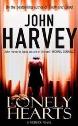
Lonely hearts - John Harvey
Lonely hearts - Harvey, John
Summary: When Shirley Peters is found strangled, her common-law husband is arrested, but a second victim appears while he is in custody, and Inspector Charlie Resnick has only a lonely hearts column to direct him to the killer - (Baker & Taylor)
Publishers Weekly Reviews
British poet and novelist Harvey introduces an appealing and memorable new series character in this, his seventh mystery. Charlie Resnick, a detective in an unnamed city in the North of England, is middle-aged, overweight, divorced and disillusioned. He is also deeply burdened by the evils that his job forces him to confront each day: child abuse, rape and murder. As one old friend puts it after seeing his photograph in the newspaper, ``You are always descending steps, Charlie, after giving evidence against some dreadful man. You always look so sad and angry.'' Featuring a variety of well-drawn cops and a fascinating array of suspects, this police procedural follows Resnick and his team as they investigate the murders of two women who shared nothing except their use of the local paper's lonely hearts column to meet men. As the investigation unfolds, an attraction develops between Charlie and welfare worker Rachel Chaplin--a romance that comes as a welcome respite from the mawkish, psycho-babbling seductions typical of current mysteries. (June) Copyright 1989 Cahners Business Information.
Check Availability
Summary: When Shirley Peters is found strangled, her common-law husband is arrested, but a second victim appears while he is in custody, and Inspector Charlie Resnick has only a lonely hearts column to direct him to the killer - (Baker & Taylor)
Publishers Weekly Reviews
British poet and novelist Harvey introduces an appealing and memorable new series character in this, his seventh mystery. Charlie Resnick, a detective in an unnamed city in the North of England, is middle-aged, overweight, divorced and disillusioned. He is also deeply burdened by the evils that his job forces him to confront each day: child abuse, rape and murder. As one old friend puts it after seeing his photograph in the newspaper, ``You are always descending steps, Charlie, after giving evidence against some dreadful man. You always look so sad and angry.'' Featuring a variety of well-drawn cops and a fascinating array of suspects, this police procedural follows Resnick and his team as they investigate the murders of two women who shared nothing except their use of the local paper's lonely hearts column to meet men. As the investigation unfolds, an attraction develops between Charlie and welfare worker Rachel Chaplin--a romance that comes as a welcome respite from the mawkish, psycho-babbling seductions typical of current mysteries. (June) Copyright 1989 Cahners Business Information.
Check Availability
Jul 1, 2013
The lost city of Z - David Grann
Lost city of Z - Grann, David
Summary: "After stumbling upon a hidden trove of diaries, New Yorker writer David Grann set out to solve 'the greatest exploration mystery of the twentieth century': what happened to British explorer Percy Fawcett. In 1925 Fawcett ventured into the Amazon to find an ancient civilization. For centuries Europeans believed the world's largest jungle concealed the glittering El Dorado. Thousands had died looking for it, leaving many convinced that the Amazon was truly inimical to humankind. But Fawcett had spent years building his scientific case. Captivating the imagination of millions, he embarked with his 21-year-old son, determined to prove that this ancient civilization--which he dubbed 'Z'--existed. Then he and his expedition vanished. Fawcett's fate--and the clues he left behind--became an obsession for hundreds who followed him. As Grann delved deeper into Fawcett's mystery, and the greater mystery of the Amazon, he found himself irresistibly drawn into the 'green hell.' "--From publisher description.
Booklist Reviews
Percy Fawcett, a celebrated member of the Royal Geographical Society, explored the Amazon the hard way: on foot, hacking his way through the jungle. Single-minded and exceptionally tough, he captured the imagination of a public hungry for tales of far-off adventure. His exploits were widely reported, especially when he told of his belief in a lost city—enigmatically, he called it "Z"—that would offer proof an advanced civilization had once thrived despite the region s hostile environment. In 1925, having vowed to find Z, he disappeared into the jungle and was never seen again. Grann, of the New Yorker, was no outdoorsman. But captivated by the story, he joined the ranks of the "Fawcett Freaks," determined to discover the explorer s fate. (It is estimated that more than 100 people have lost their lives trying to find out how Fawcett lost his.) He interweaves Fawcett s story with rich period detail and an account of his own trip to the receding jungle. The historical passages, peerlessly researched, are the best; the first-person parts could have been a useful way of illustrating the tale s irresistible lure—but compared to Fawcett s relentless monomania and astonishing travels, Grann s own journey pales. The device pays off in the final scene, however, when, through Grann s own eyes, we experience the thrill of discovery—and learn that Percy Fawcett just may have been right all along. Copyright Booklist Reviews 2008.
Check Availability
Summary: "After stumbling upon a hidden trove of diaries, New Yorker writer David Grann set out to solve 'the greatest exploration mystery of the twentieth century': what happened to British explorer Percy Fawcett. In 1925 Fawcett ventured into the Amazon to find an ancient civilization. For centuries Europeans believed the world's largest jungle concealed the glittering El Dorado. Thousands had died looking for it, leaving many convinced that the Amazon was truly inimical to humankind. But Fawcett had spent years building his scientific case. Captivating the imagination of millions, he embarked with his 21-year-old son, determined to prove that this ancient civilization--which he dubbed 'Z'--existed. Then he and his expedition vanished. Fawcett's fate--and the clues he left behind--became an obsession for hundreds who followed him. As Grann delved deeper into Fawcett's mystery, and the greater mystery of the Amazon, he found himself irresistibly drawn into the 'green hell.' "--From publisher description.
Booklist Reviews
Percy Fawcett, a celebrated member of the Royal Geographical Society, explored the Amazon the hard way: on foot, hacking his way through the jungle. Single-minded and exceptionally tough, he captured the imagination of a public hungry for tales of far-off adventure. His exploits were widely reported, especially when he told of his belief in a lost city—enigmatically, he called it "Z"—that would offer proof an advanced civilization had once thrived despite the region s hostile environment. In 1925, having vowed to find Z, he disappeared into the jungle and was never seen again. Grann, of the New Yorker, was no outdoorsman. But captivated by the story, he joined the ranks of the "Fawcett Freaks," determined to discover the explorer s fate. (It is estimated that more than 100 people have lost their lives trying to find out how Fawcett lost his.) He interweaves Fawcett s story with rich period detail and an account of his own trip to the receding jungle. The historical passages, peerlessly researched, are the best; the first-person parts could have been a useful way of illustrating the tale s irresistible lure—but compared to Fawcett s relentless monomania and astonishing travels, Grann s own journey pales. The device pays off in the final scene, however, when, through Grann s own eyes, we experience the thrill of discovery—and learn that Percy Fawcett just may have been right all along. Copyright Booklist Reviews 2008.
Check Availability
Double jeopardy - Jean Echenoz
Double jeopardy - Echenoz, Jean
Library Journal
In this fast-moving tale, reminiscent of a detective novel, Echenoz crosses the boundaries of time and space as he introduces us to Charles and Jeff, who were in love with Nicole 30 years ago; Paul, Jeff's nephew, who falls for Justine, Nicole's daughter by a dead pilot; and Bob, Paul's friend. Bob and Paul unwittingly duplicate Charles and Jeff's past pursuit of Nicole, as they both try to win the love of her daughter. In the background, and setting the pace for the story, is the subplot of an arms-smuggling campaign to Malaysia, where Jeff manages a rubber plantation. The off-beat characters are delightful and well drawn, and their curious relationships will keep the reader entertained until the last page. The author is the winner of the Medici Prize for Cherokee (Godine, 1987) and the European Literature Prize for his best-selling Lac. -- Peggie Partello, Keene State Coll., N.H.
Copyright 1993 Reed Business Information, Inc.
Check Availability
Library Journal
In this fast-moving tale, reminiscent of a detective novel, Echenoz crosses the boundaries of time and space as he introduces us to Charles and Jeff, who were in love with Nicole 30 years ago; Paul, Jeff's nephew, who falls for Justine, Nicole's daughter by a dead pilot; and Bob, Paul's friend. Bob and Paul unwittingly duplicate Charles and Jeff's past pursuit of Nicole, as they both try to win the love of her daughter. In the background, and setting the pace for the story, is the subplot of an arms-smuggling campaign to Malaysia, where Jeff manages a rubber plantation. The off-beat characters are delightful and well drawn, and their curious relationships will keep the reader entertained until the last page. The author is the winner of the Medici Prize for Cherokee (Godine, 1987) and the European Literature Prize for his best-selling Lac. -- Peggie Partello, Keene State Coll., N.H.
Copyright 1993 Reed Business Information, Inc.
Check Availability
Mar 1, 2013
Lovestar - Andri Snæ Magnason
Lovestar - Magnason, Andri Snæ
Summary: In a device-free world dominated by wave-transmitted consumerism where people are controlled by technological trends, blissfully happy young lovers Indridi and Sigrid are declared to have a scientifically invalid relationship and are forced to go to extreme lengths to prove their love. - (Baker & Taylor)
Publishers Weekly Reviews
In this outlandish yet poignant dystopian allegory, Magnason (Dreamland: A Self-Help Manual for a Frightened Nation) imagines a post-technological world in which the relationship between people and information is turned on its head. "Cordless" citizens are freed from gadgets and wires while REGRET, something like a retroactive Magic 8 Ball if envisioned by Vonnegut, renders every choice the right one. Louts hoping to pay down debt become "ad howlers," "AdTraps," and "Secret Hosts"—human bullhorns spouting targeted advertisements or post-purchase praise ("YOU WERE UNBELIEVABLY COOL TO BUY SUCH GROOVY SHOES!") to pedestrians. At funerals run by LoveDeath, bodies are launched into space and mourners watch their loved ones "burn up under the heavenly plough" upon re-entry. At the helm of this carefully monitored and controlled society is LoveStar, a God-like old man with three hours left to live and a mission to "free people from the oppression of freedom." Then there's Indridi and Sigrid, who want to stick together despite inLOVE's calculation of Sigrid as better matched with a Danish man. Orwell, Vonnegut, and Douglas Adams are felt on every page, though Magnason is never derivative. His satire and insightful social commentary sweeten the pot and the sheer wackiness of Magnason's oversized imagination is invigorating. (Nov.)
Check Availability
Subscribe to:
Posts (Atom)